
Stop losing bookings to missed calls. Discover how AI receptionists help massage clinics and medical spas capture every appointment, 24/7, without hiring extra staff.
It’s 7.15pm on a Tuesday evening. Sarah runs a thriving massage clinic in Manchester. She’s just finished her last appointment of the day when her mobile buzzes. It’s a text from a potential client: “Tried calling twice today but no answer. Booked somewhere else now.”
Sarah checks her phone system. Two missed calls at 1.30pm. Right in the middle of back-to-back appointments.
That’s £85 gone. Just like that.
This happens more often than most spa owners realise. You’re running a brilliant business, your clients love you, your therapists are fully trained. But you’re losing bookings simply because no one picks up the phone.
The solution isn’t hiring another staff member. It’s implementing an AI receptionist for massage and spas a system that handles your calls 24/7 whilst you focus on what you do best.
This guide explains exactly how AI receptionists work for massage clinics and medical spas, what they should and shouldn’t do, and how to set one up without disrupting your existing operations.
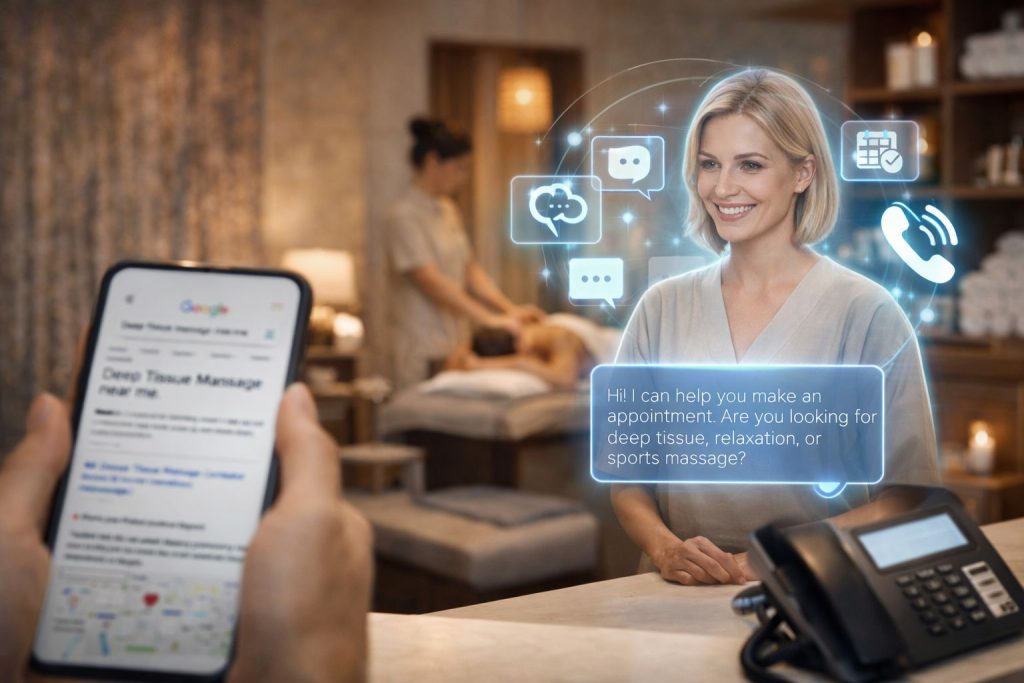
An AI receptionist is software that answers your business phone line 24/7. It sounds like a real person, understands natural conversation, and handles common requests without human intervention.
Think of it as your most reliable team member. One who never takes a day off, never gets flustered during rush hour, and always sounds warm and professional.
Unlike old-school automated phone menus with “press 1 for appointments”, modern AI receptionists use conversational voice technology. They chat naturally with callers, understand context, and adapt to different situations.
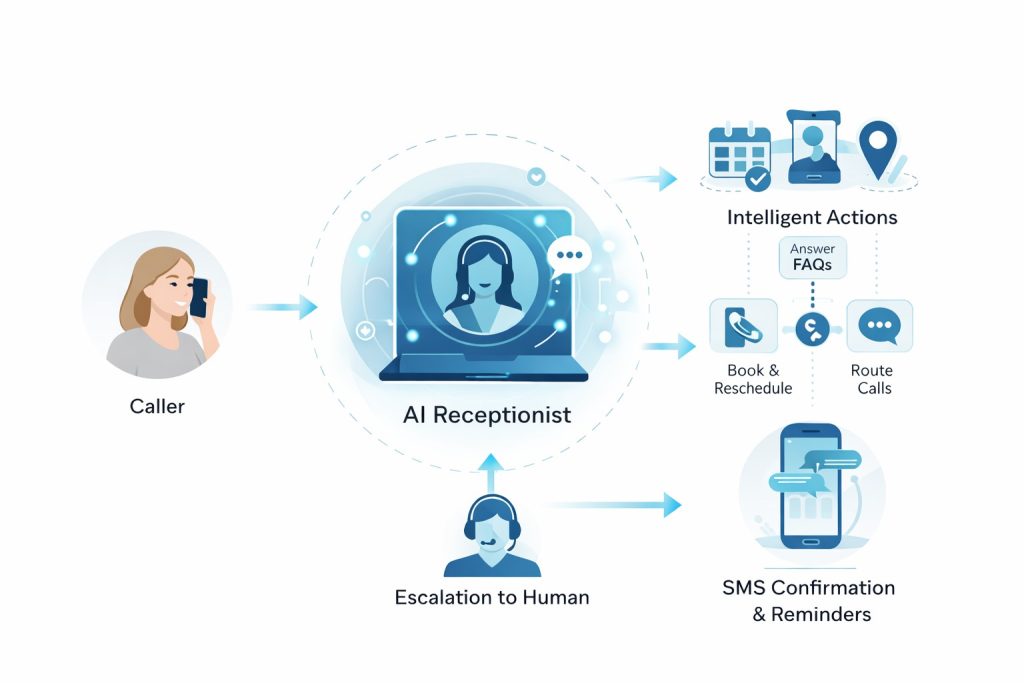
For spas specifically, this means handling appointment bookings, answering frequently asked questions about treatments, taking messages, and knowing when to escalate to a real person.
The technology has improved dramatically in the past 18 months. These systems now understand regional accents, handle interruptions gracefully, and integrate with your existing booking software.
Most spa owners don’t have a phone problem. They have a timing problem.
Calls come in when you’re mid-treatment. When you’re consulting with a client about their skincare concerns. When you’re setting up for the next appointment. When you’ve finally sat down for lunch.
Your potential clients don’t know you’re busy. They just know no one answered.
Someone rings at 2pm on a Thursday. Your reception desk is empty because your receptionist is covering for a therapist who called in sick. The caller waits through four rings, then hangs up. They open Google and call the next clinic down the list.
Not because your service isn’t excellent. Because your phone went unanswered for 30 seconds.
The out-of-hours problem compounds this. A third of spa enquiries happen after 6pm or at weekends. People browse treatment options whilst watching TV. They get excited about a facial package. They want to book right then.
If your phone just rings out, they’ll book elsewhere. Speed matters more than most clinic owners think.
There’s also the friction factor. When someone finally does reach you during a busy period, the conversation feels rushed. Your receptionist is juggling three tasks. The caller senses it. The experience feels transactional rather than welcoming.
Medical spas face an additional challenge. Many enquiries are about injectables, skincare procedures, or body contouring. These calls need careful handling. Callers want reassurance and detail. They’re spending serious money. A frazzled three minute chat doesn’t build the confidence needed to book. This is precisely why an AI receptionist for massage and spas has become essential it ensures every caller receives professional, unhurried attention regardless of how busy your clinic is.
Let’s get specific about use cases that actually work in spa environments.
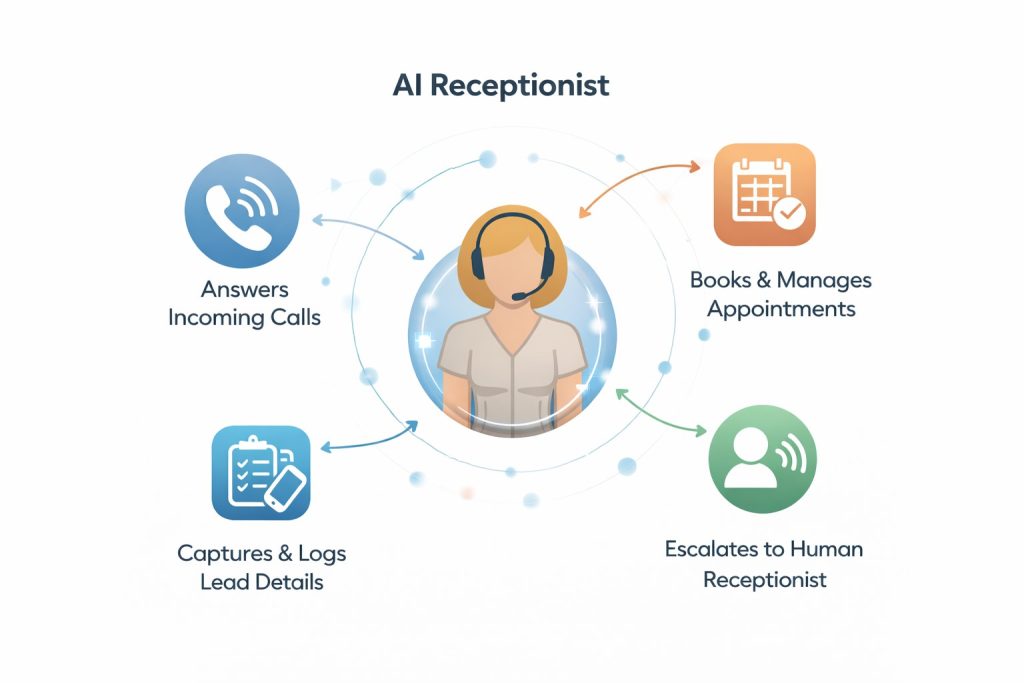
Appointment booking is the obvious one. An AI receptionist can check your calendar, find available slots, and book appointments for standard treatments. Swedish massage, deep tissue, facials, manicures. Anything with clear duration and pricing.
The system asks the right questions. Name, contact details, preferred therapist if relevant, any allergies or health conditions to note. It confirms the appointment time, explains your cancellation policy, and sends a confirmation text.
Answering FAQs saves enormous time. What are your opening hours? Do you offer couples massage? How much is a 60-minute deep tissue? What’s included in the signature facial? Is parking available?
These questions come up repeatedly. An AI receptionist handles them instantly whilst your team focuses on clients in the building.
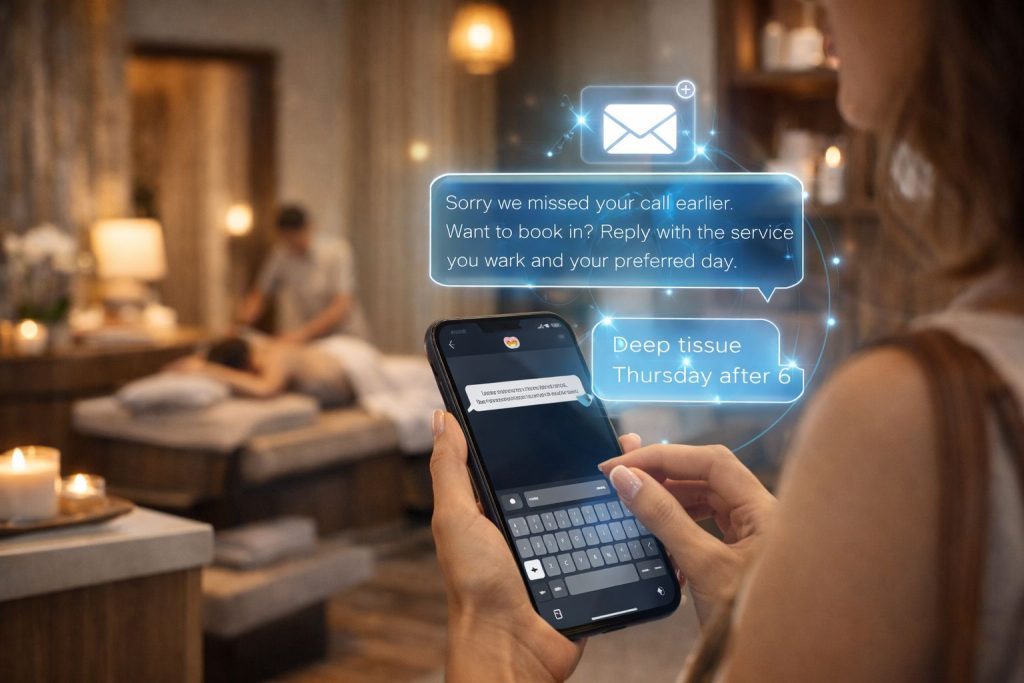
Missed call text back is brilliantly simple. If someone calls when your AI is handling another call, or if they hang up quickly, the system sends an immediate text: “Hi, I saw you tried to reach us. I’m your virtual receptionist. Would you like to book an appointment or shall I have someone call you back?”
This alone captures bookings that would otherwise vanish.
Taking detailed messages for complex enquiries. If someone calls about a medical spa treatment that needs consultation, the AI doesn’t try to book it. Instead, it gathers the caller’s details, notes exactly what they’re interested in, and promises a callback within a specific timeframe.
Handling rescheduling requests during busy periods. A client calls to move their Thursday appointment. Your receptionist is mid-checkout with another client. The AI checks availability, offers alternatives, and confirms the new booking. Done in two minutes.
Providing directions and preparation instructions. Someone booked online but can’t remember where you’re located. Or they need to know whether to arrive with clean skin for their facial. The AI provides clear information without interrupting your team.
Qualifying leads for medical spa treatments. Before someone books Botox or dermal fillers, the AI can ask screening questions. Have you had this treatment before? Any allergies to local anaesthetic? Are you pregnant or breastfeeding? This information gets passed to your medical team for proper evaluation.
Confirming appointments via outbound calls or texts. The system can ring clients the day before to confirm they’re still coming. This reduces no-shows significantly.
Clear boundaries matter. Here’s where humans must stay in control.
Clinical advice is completely off-limits. An AI receptionist should never diagnose, recommend treatments for specific conditions, or provide medical guidance. If someone asks whether they’re suitable for a particular procedure, the answer is always: “Our practitioner will assess that during your consultation.”
Handling complaints needs human empathy. If a caller is unhappy about a previous treatment or service, the AI should apologise for their experience and immediately connect them to a manager or senior team member.
Discussing sensitive medical information beyond basic screening questions. Detailed health history, current medications, mental health considerations. These conversations require privacy and professional judgment.
Making price adjustments or exceptions without approval. Your pricing is your pricing. The AI quotes standard rates and explains package options but never offers discounts or negotiates.
Booking treatments that require medical consultation as standard appointments. Injectables, chemical peels, laser treatments, anything prescription-based. These need proper assessment first.
Overriding your escalation rules. You’ll define situations where the call must go to a human immediately. Urgent issues, VIP clients, complex situations. The AI follows those rules without exception.
Think of it this way. Your AI receptionist handles routine admin brilliantly. But it knows its limits and hands over gracefully when human judgment matters.
Most spa owners worry an AI receptionist is an unnecessary expense. Let's do the maths.
£19,000
Lost revenue annually from missed calls
£3,600
Annual cost of AI receptionist
5x
Return on investment
Say you currently miss 10 calls per week because you’re busy. That’s 40 missed calls monthly. If your conversion rate from enquiry to booking is 60%, you’re losing 24 appointments every month.
Average treatment value across massage and facial services is around £65. That’s £1,560 in lost revenue monthly. Nearly £19,000 annually.
An AI receptionist for massage and spas costs between £97 and £297 monthly depending on features and call volume. Even at the higher end, you’re spending £3,600 yearly to protect £19,000 in revenue.
But revenue protection is just one part. You’re also reclaiming staff time. If your receptionist currently spends 90 minutes daily answering routine questions and booking standard appointments, that’s 7.5 hours weekly.
At £12 per hour, you’re spending £4,680 yearly on tasks an AI handles automatically. Redirect that time to higher-value work. Client care, marketing, inventory management, whatever moves your business forward.
No-show reduction adds another layer of ROI. AI systems that confirm appointments via call or text typically reduce no-shows by 30-40%. If you currently have eight no-shows monthly at an average value of £65, preventing even half saves £2,000 yearly.
Extended booking hours bring new revenue. When clients can book at 9pm or Sunday afternoon, you capture demand that previously went elsewhere. Even five extra bookings monthly at £65 each adds £3,900 annually.
Better client experience has compound effects. People notice when their call is answered professionally within seconds, any time of day. They tell friends. They book again. Client lifetime value increases.
Add it up. You’re looking at £25,000 to £30,000 in protected and new revenue annually, plus reclaimed staff time and operational efficiency. The investment pays for itself many times over.
Let's walk through how this actually works.
It's Wednesday morning, 11.15am. Your therapist is mid-treatment. A new caller rings.
The AI receptionist answers within two rings: "Good morning, you've reached Serenity Spa in Bristol. I'm Alex, your virtual receptionist. How can I help you today?"

Caller: "Hi, I'd like to book a massage please."

AI: "Lovely. I can help with that. Are you looking for a Swedish massage, deep tissue, or hot stone?"

Caller: "Deep tissue, please. My shoulders are killing me."

AI: "I understand. A 60-minute deep tissue massage is perfect for tension. When would suit you? We have availability this week on Thursday afternoon and Friday morning."

Caller: "Friday morning works."

AI: "Great. I have Friday at 10am or 11.30am. Which works better?"

Caller: "11.30 is perfect."

AI: "Wonderful. Can I take your name and mobile number please?"
The AI collects details, confirms the £75 price, explains the 24-hour cancellation policy, and sends a confirmation text immediately.
Total call time: two minutes. Booking secured. Your therapist never interrupted.
Thursday afternoon, 3.45pm. Your aesthetic practitioner is with a client. The phone rings.
AI: "Good afternoon, you've reached Glow Medical Spa in Leeds. I'm Sam, your virtual receptionist. How may I assist you?"

Caller: "I'm interested in getting lip fillers. Can I book an appointment?"

AI: "Absolutely. We offer dermal filler treatments with our qualified practitioner. Before we book a treatment, you'll need an initial consultation where we discuss your goals and assess suitability. May I book you in for a consultation first?"

Caller: "Oh, okay. Yes please."

AI: "Perfect. Consultations take about 20 minutes and they're complimentary. We have availability next Tuesday at 4pm or Wednesday at 2pm."

Caller: "Tuesday works."

AI: "Excellent. Can I take a few quick details? Have you had dermal fillers before?"
The AI gathers basic information, books the consultation, and sends details including what to expect and preparation guidance.
The practitioner reviews the notes before the appointment. Everything they need to know. No back-and-forth emails.
Saturday evening, 7.20pm. Your spa closed at 6pm. Someone calls your business number.
The AI answers: "Thank you for calling Haven Spa. We're currently closed but I'm your 24-hour virtual receptionist. I can help you book an appointment or answer questions about our treatments."

The caller hangs up, perhaps not expecting an answer after hours.

Immediately, your system sends a text: "Hi there. I saw you called Haven Spa this evening. I'm available now to help you book a treatment or I can have the team call you Monday morning. What works best?"

Three minutes later, the caller replies: "Can I book a couples massage for next Saturday?"
The AI responds via text, confirms availability, collects both names and contact details, and books the appointment.
By Sunday morning, you wake up to a confirmed £180 booking that would have been lost entirely without 24/7 coverage.
Not all AI receptionist systems are built equally. When choosing an AI receptionist for massage and spas, specific features matter more than others. Here's what actually matters for spas.
Fancy AI features you’ll never use. Video call capabilities, advanced sentiment analysis, predictive booking. These sound impressive but add cost without practical benefit for most spas.
Overly complex setup. If it takes weeks to configure and requires technical expertise, it’s too complicated.
Systems that try to do everything. Booking, inventory, payroll, marketing. You want specialist phone handling, not another all-in-one platform.
Pay attention to the trial period. Reputable providers let you test for at least two weeks. That’s enough time to see how it handles real calls.
Check whether you’re locked into long contracts. Monthly rolling agreements give flexibility. Annual commitments should come with significant discounts.
Ask about call volume limits. Some providers charge per minute. Others offer unlimited calls within your plan. Understand the pricing structure fully.
Here's how a perfect call should unfold, step by step.
Greeting: Warm, professional, immediate. “Good morning, you’ve reached Tranquil Touch Spa. I’m Jordan, your virtual receptionist. How may I help you today?”
Intent capture: What does the caller actually want? Booking, information, rescheduling, complaint? Get clarity fast. “Are you looking to book a treatment, or do you have a question about our services?”
Essential information gathering: Only ask what’s needed for this specific request. Name, contact, preferred treatment, date flexibility. Don’t interrogate.
Confirmation: Repeat key details back. “Perfect, so that’s a 60-minute aromatherapy massage next Wednesday at 2pm. The price is £70 and we ask for 24 hours notice for cancellations.”
Booking or handoff: Either complete the booking and send confirmation, or transition smoothly to a human: “This sounds like something our spa manager should discuss with you personally. I’ll transfer you now.”
Warm close: End positively. “Brilliant, your appointment is confirmed and you’ll receive a text shortly. We look forward to seeing you on Wednesday. Have a lovely day.”
The entire flow takes two to four minutes for standard bookings. No wasted words. No robotic statements. Just efficient, friendly service.
Good scripts sound natural. Here are examples your AI receptionist might use.
“Lovely, I can help with that. Our most popular massages are Swedish for relaxation, deep tissue for tension, and hot stone for ultimate indulgence. Which appeals to you?”
“Perfect choice. Our deep tissue massage is 60 or 90 minutes. The 60-minute session is £75 and focuses on your main problem areas. The 90-minute is £105 and gives us time to work through your whole body. Which suits you better?”
“Thank you for your interest in our skincare treatments. For anti-wrinkle injections, we always start with a consultation so our practitioner can assess your skin and discuss the best approach for your goals. Consultations are free and take about 20 minutes. Would you like to book one?”
“Our signature facial is £85 for 60 minutes. That includes deep cleansing, exfoliation, a customised mask, and a relaxing face and shoulder massage. It’s one of our most popular treatments. Would you like to book in for one?”
“That’s a really good question and I want to make sure you get accurate information. Let me connect you with one of our spa coordinators who can explain the options properly. Just one moment please.”
Notice the language. Friendly but professional. No unnecessary fluff. No corporate jargon. Just clear, helpful conversation.
Don't activate your AI receptionist across all calls on day one. That's asking for trouble.
Start with out-of-hours coverage. Let it handle calls when you’re definitely closed. Evenings, weekends, bank holidays. There’s zero risk because the alternative is no answer at all.
Run this for two weeks. Monitor the calls. Listen to recordings. Check what bookings come through. Adjust scripts based on how real people phrase things.
Phase two: Add rescheduling and FAQs during business hours. Let the AI handle these specific request types whilst complex bookings still go to humans. This lets your team focus on in-person clients.
Run for another two weeks. You’ll quickly see how much time it saves.
Phase three: Standard treatment bookings. Massages, basic facials, manicures, anything straightforward. Keep consultation-required treatments in human hands.
Again, two weeks minimum. Build confidence gradually.
Phase four: Full deployment. The AI handles all appropriate calls. Medical consultations, VIP clients, and complex situations still escalate immediately.
Throughout every phase, review call recordings weekly. Look for:
Refine constantly. Your AI receptionist gets better with iteration.
Keep your team informed at every stage. Explain what the AI will handle and what still comes to them. No surprises. No feeling replaced. Just clear communication about a tool that makes their jobs easier.
Before you activate your AI receptionist, you need these elements ready.
Having these documented makes setup fast. Most systems can be configured in a few hours once you've done this preparation.
Metrics to Track Weekly
You can't improve what you don't measure. Check these numbers every week.
Total calls answered: How many calls came in? What times of day? Which days are busiest?
Missed calls: Despite having AI, some calls might still slip through during system maintenance or technical issues. Track these.
Leads captured: How many new enquiries did the AI handle? How many left contact details?
Bookings completed: How many appointments did the AI actually book? What’s the average booking value?
Escalations to humans: How often does the AI hand over to staff? Are these appropriate escalations?
No-show rate: Compare before and after AI implementation. Has appointment confirmation reduced no-shows?
Response time: How quickly does the AI answer? Average should be under three rings.
Conversation duration: How long are calls taking? Extremely short might mean callers are confused. Extremely long might mean scripts need tightening.
Call recordings review: Listen to five random calls weekly. What’s working? What’s not?
Client feedback: Ask clients who booked via AI how the experience was. Include one question in your post-appointment feedback: “How was your experience booking your appointment?”
Set targets. Perhaps you want 95% of calls answered, 70% of enquiries converted to bookings, and no-shows below 8%.
Review monthly trends. Are bookings increasing? Is the system handling more call types independently? Are escalations decreasing as scripts improve?
Data tells you whether your AI receptionist is genuinely improving operations or just adding complexity.
Most systems disclose this in the greeting, and it’s good practice to be transparent. The phrase “I’m your virtual receptionist” works well. Some clients notice immediately, others don’t. What matters is whether the service is helpful and efficient.
Good systems include easy override mechanisms. If a booking goes through incorrectly, your team can amend it just like any other appointment. The AI learns from corrections. Most providers also let you review calls before they result in confirmed bookings if you prefer that safety net initially.
Modern AI receptionists are trained on diverse UK accents. Scottish, Welsh, various English regional accents. They’re not perfect with very strong local dialects but they’ve improved enormously. The technology gets better monthly.
Most AI receptionist systems integrate with major booking platforms like Fresha, Timely, Phorest, Vagaro, and Acuity. Some also work with Google Calendar or Outlook. Check compatibility before committing. If direct integration isn’t available, some systems can create booking requests your team confirms manually.
Callers can always request a human. The AI asks if they’d prefer to be transferred or receive a callback. During business hours, transfers happen instantly. Outside hours, the system takes detailed messages and prioritises urgent matters.
Pricing typically ranges from £150 to £400 monthly depending on call volume and features. Many providers offer tiered plans. Start small and scale as you see ROI. Most spa owners find it costs less than hiring part-time reception cover.
Initial configuration takes a few hours if you’ve prepared your information. Fine-tuning happens over the first few weeks as you adjust scripts based on real calls. Most spas are fully operational within a month.
Yes, most systems include SMS or email reminders. You can typically set these for 24 hours or 48 hours before appointments. Some also send follow-up messages asking for feedback or encouraging rebooking.
Your spa deserves better than missed calls, rushed phone conversations, and bookings lost to competitors simply because someone picked up faster.
An AI receptionist for massage and spas doesn’t replace your team it enhances what you already do brilliantly. It protects your revenue, reclaims your time, and ensures every potential client gets the professional, welcoming experience your business is known for.
Start small. Test with out-of-hours calls. Build confidence. Scale gradually. Within weeks, you’ll wonder how you ever managed without it.
The technology is proven. The ROI is clear. The setup is straightforward.
Ready to stop losing bookings? Request a tailored call flow and script templates designed specifically for massage and medical spas. See exactly how an AI receptionist for massage and spas would sound with your brand voice, your treatments, and your policies.
Your phone should be an asset, not a source of stress. Make it work for you, 24 hours a day.